Allegheny County’s Climate Action Working Group
By Griffin Rose, Climate Engagement Extern (Summer ’26) and Masters of Museum Studies Graduate Student at Cooperstown Graduate Program (’27)
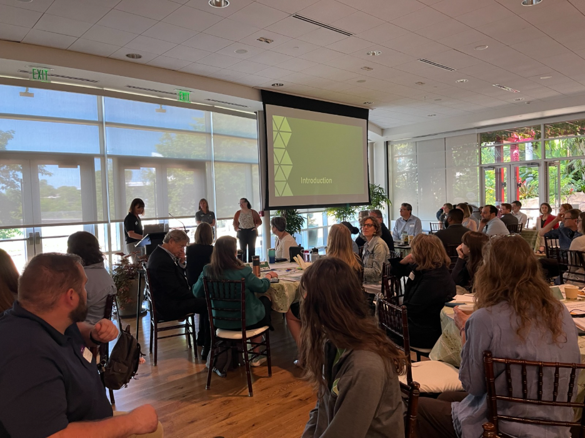
On June 3, the Allegheny County Climate Working Group met in person at Phipps Conservatory for its third and final Climate Action Plan meeting. Over the past year, the Climate Working Group has gathered many stakeholders, including local organizations, agencies, and institutions, to help plan the implementation of green initiatives to meet the goal of carbon neutrality across the entirety of Allegheny County.
This event convened more than 40 people from many different non-profit organizations and companies representing Greater Pittsburgh and Allegheny County. They have gathered discuss the future of sustainability and climate change mitigation through the lens of creating a Climate Action Plan (CAP). Development of the CAP is being led by the Allegheny County Department of Sustainability and aims to achieve the ambitious target of a carbon neutral county by 2050. At these Climate Working Group meetings, local organizations involved in recycling, sustainability, and advocacy sectors held discussions about systemic changes that support mitigation of greenhouse gas and improve institutional resilience to climate change. These discussions elevated the core values of the Climate Working Group, which are improving public and ecological health. This ensures accessibility to participation in climate solutions to all communities, and creates more opportunities for economic growth in a greener Allegheny County.
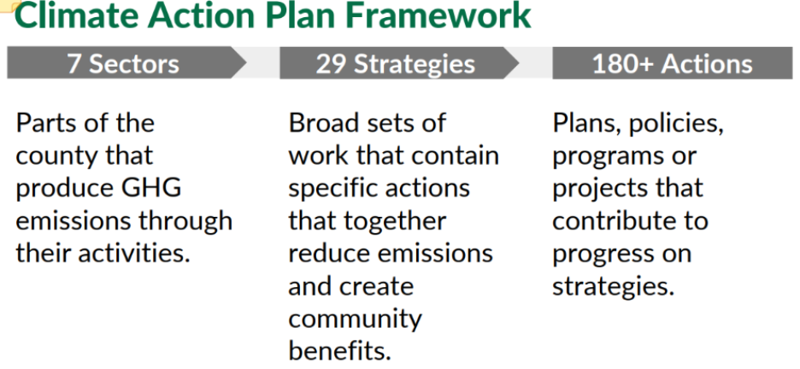
The Working Group focused on seven specific areas of interest for the Climate Action Plan. These seven sectors included: Waste & Resources, Natural Systems, Food & Water, Buildings & Infrastructure, Electricity Grid, Industry & Fuel, and Transportation. Nested into each of these sectors are strategies that broadly lay out a path of sustainability that Allegheny County can take to fight climate change by reducing emissions and improving resilience of infrastructure. To make implementation of these strategies easier, each has been further broken down into actions, specific projects and policies that can be implemented on local, county, and statewide levels.
Each of these strategies is based on emissions modeling done by local consultants evolveEA, ICF, and Black Girl, Green World. These models are fluid; it’s understood that there are sectors in which emissions are difficult to quantify, and, as climate change is better understood, the Climate Action Plan’s suggestions are subject to change. While more research is performed and the understanding of the scope of climate change extends, underrepresented, and even unconsidered, areas are revealed and must be taken into account. Structuring the Climate Action Plan to account for these changes as we learn more and grow as a community shows that the leaders of the program are very forward-thinking and attuned to climate science.
The meeting was structured in three parts:
- an initial presentation to get attendees caught up with the most recent projections and models of climate change in Allegheny County;
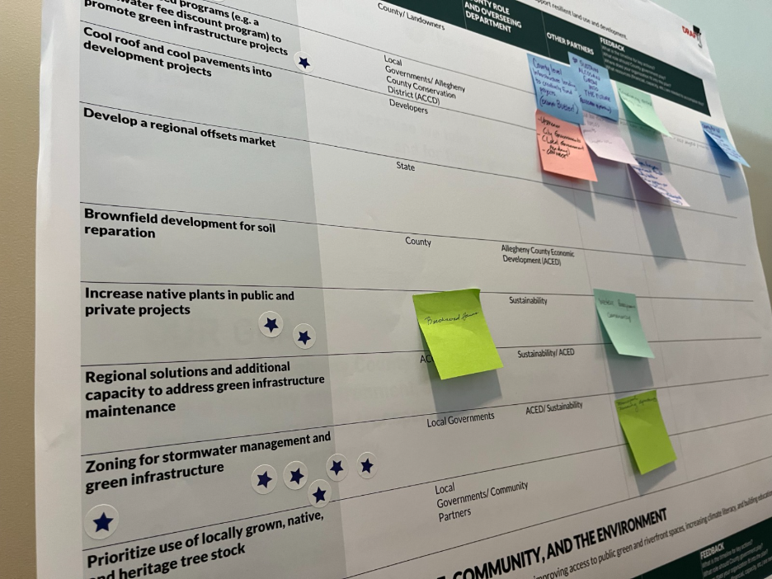
- a poster session, in which attendees reviewed the CAP, made suggestions, and organizations volunteered to lead certain actions;
- and a collaborative session, in which each sector group sat down and discussed what specific actions could be taken in the field to facilitate the adoption of the CAP.
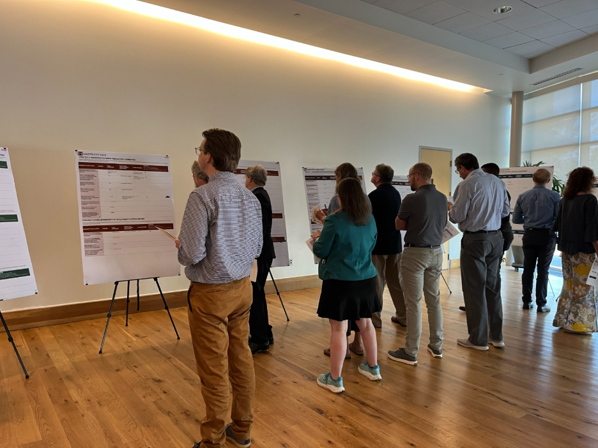
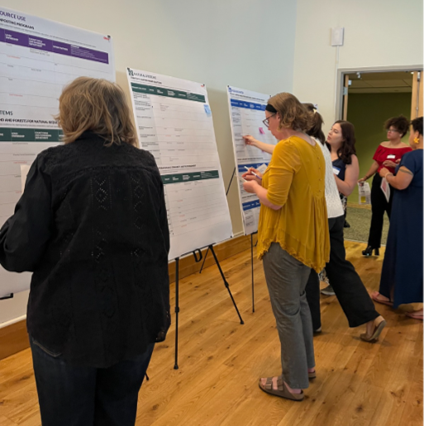
The presentation’s focus was to get the attendees on the same page about the state of sustainability infrastructure in Allegheny County and current projections of climate change and emissions. The goal of the poster session was to have all the attendees review the sectors, strategies, and actions. To do this, each attendee could add star stickers to actions they believed should be prioritized, write comments on sticky notes to give specific feedback on actions, and volunteer their organizations for leading actions by placing another sticker.
One of the main focus areas was the decarbonization of the energy grid. Electricity consumption is estimated to rise over 60% by 2050 because many climate action initiatives rely on electricity in one way or another to perform their own decarbonization duties. A fully decarbonized grid is vital to improve returns across other sectors. A major source of contention was the energy cost of proposed data centers, one of which could account for up to 10% of the energy cost. One of the ideas to help mitigate any issues that could arise was to establish an energy authority in the area that would be able to more easily track energy usage for better constraints on emissions. The communities these centers would affect were a topic of great concern.
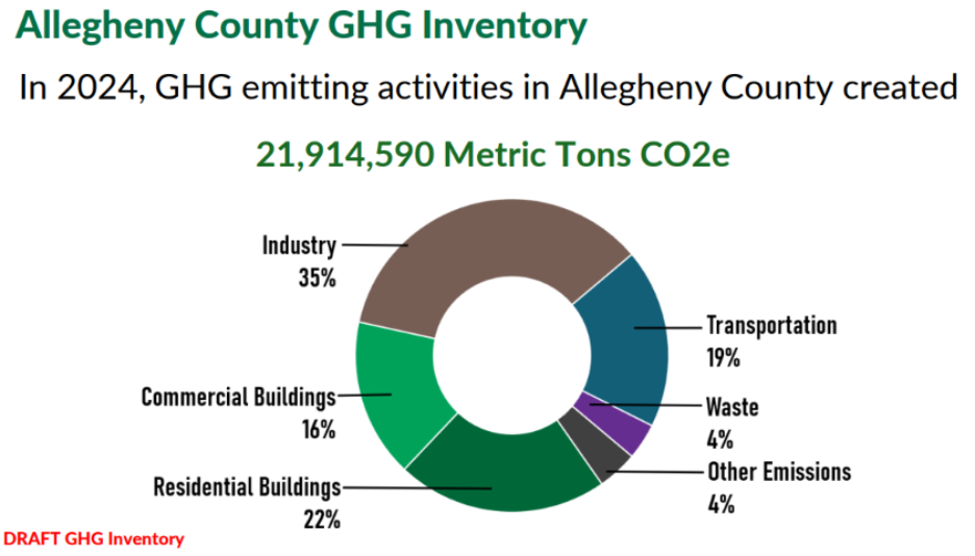
Many of the plans focus on decarbonization of current infrastructure, implementation of new carbon free initiatives, and designing adaptable buildings that are resilient in the face of climate change. Decarbonization of many parts of current infrastructure that are currently in place would help to move toward the goal of carbon neutrality by 2050. The emphasis of the Climate Working Group is on the future, but it was noted that since 2022, there has been a decrease of 19% of greenhouse gas emissions.
The poster session was the highlight of the workshop and as the posters slowly filled with star stickers and sticky notes, it created a positive impression of a community of professionals all working toward a common goal. Open collaboration is a prerequisite for any interdisciplinary initiative like the Climate Action Plan, and, ironically, one of the most difficult parts of these projects is keeping each group informed about what the others are doing. The poster session was structured to allow attendees to see which action had more support and discuss broad solutions that would require work from multiple sectors.
Once the poster review session concluded, there was an opportunity to sit in on discussions in each of the action sectors. At the Waste & Resources table, professionals in waste management and recycling fields workshopped plans for dealing with waste across Pittsburgh. After acknowledging that there is not yet infrastructure in place to move toward a “Zero Waste” city, it is important to note the phrase “Zero Waste” does not mean a city devoid of trash, but rather a city that has the capability to mitigate the waste it produces in an environmentally conscious way. Increased access to recycling infrastructure and the scope of recycled material proved a good place to start. When many people think about recycling, they think mainly about metal, paper, and some plastics. During the discussion at the Waste & Resources table, recycling focused much more on the reuse of building materials, industrial scale composting, and improving educational resources, so people know what can be recycled and the process of recycling different types of waste.
While the Climate Action Plan moves towards full release and implementation, non-profit organizations around Pittsburgh that are not directly associated with climate movements should be ready to join the discussion. For information about upcoming public meetings and other events, visit the Allegheny County Department of Sustainability website.
